
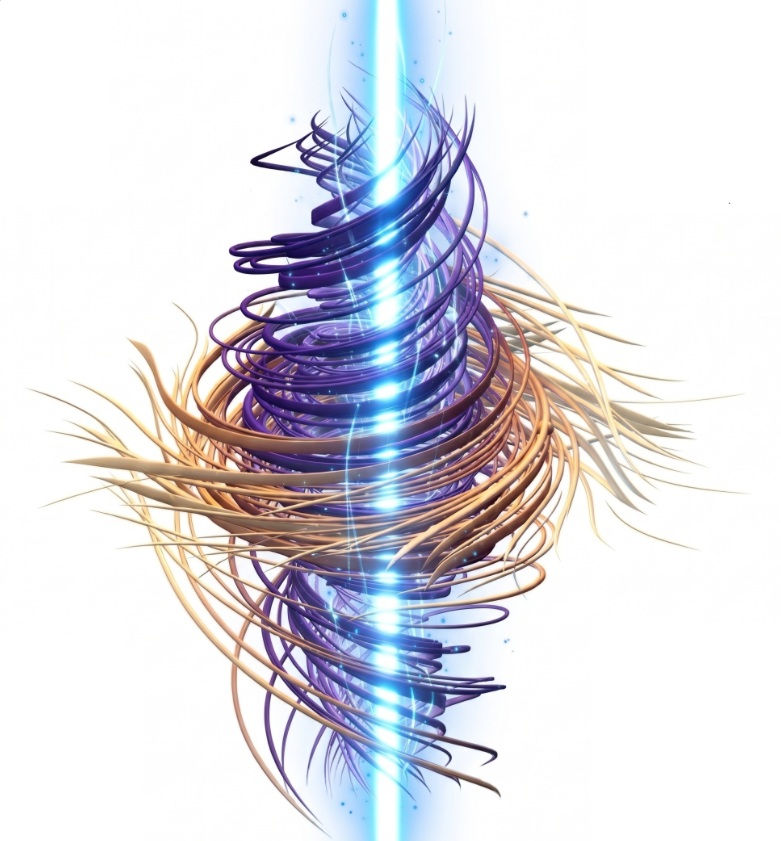
Navier-Stokes Equation
The Navier-Stokes equations are, in their most basic form, Newton's Second Law applied to liquid and gaseous fluids. They mathematically describe how each drop of water or gust of air moves and changes shape in response to the forces acting upon it.

Instead of calculating the motion of a solid object, the equation balances four simultaneous factors in a continuously flowing stream:
Inertia (Mass and acceleration): The tendency of the fluid to continue moving by its own momentum.
Pressure: The push from high pressure areas towards low pressure areas.
Viscosity: The internal "friction" that opposes movement (the difference between moving honey or moving water).
External Forces: Gravity or other forces that pull on the system.
Why are they almost impossible to solve analytically?
Although mathematicians Claude-Louis Navier and George Stokes formulated these equations in 1822, finding an exact solution (a closed formula with pencil and paper) is virtually impossible for two physical and mathematical reasons:
1. "Nonlinearity" (the fluid pushes itself) In acoustic or light waves, signals can cross paths in space without distorting each other (linear behavior). In fluid dynamics, the velocity of a water current alters the physical environment through which that same current will pass. Mathematically, this creates a feedback loop where a microscopic change is amplified and distorts the entire flow.
2. Chaos and the Cascade of Turbulence When a flow ceases to be ordered and becomes turbulent, large eddies break down into smaller eddies, and these in turn into microscopic ones, transferring energy in a cascading fashion. Calculating this is like trying to predict the exact trajectory of each person in a panicked crowd, assuming that the movement of one affects everyone else simultaneously.
On September 8, 2026, OpenAI publicly announced that a new internal AI model (not yet commercially released) had successfully solved the Navier-Stokes existence and smoothness problem. The AI converged on the exact solution on September 5, 2026, after 88 hours of continuous work, and mathematically verified it on September 6.
The Millennium Problem asked whether equations always remain "smooth" and predictable in three dimensions, or whether they collapse under certain extreme conditions. AI has shown that Navier-Stokes mathematics does indeed collapse .
The system discovered a formal counterexample: it designed a scenario where a fluid forms a spaghetti-like vortex that spins toward a central point. As this vortex shrinks, the fluid's velocity increases without bound until it becomes mathematically infinite in a finite amount of time (a phenomenon known as a singularity or blowup ). The AI demonstrated that in this vortex, acceleration, pressure, and viscosity reach massive values, but they cancel each other out exactly, allowing the collapse to occur according to the rules of the equation.